

AgSn TLP Sheet for Power Semiconductors
Source: May 6, 2025
PCIM Magazine
TANAKA PRECIOUS METAL TECHNOLOGIES, which is responsible for the industrial precious metals business of the TANAKA Group, has announced the development of “AgSn TLP Sheet,” a sheet-type bonding material designed for die bonding in the manufacture of power semiconductor packages. This product is also expected to serve as an alternative material for thermal interface materials (TIMs) in large-area bonding of heat sinks, and further expansion of its applications is anticipated.
Sheet-like bonding material for bonding large silicon chips with high current
In recent years, demand for high current power semiconductors has been increasing, mainly for use in electric vehicles, hybrid vehicles, and industrial infrastructure. As a result, materials that can enable large-area bonding while ensuring high reliability are required for bonding large silicon chips. The newly announced AgSn TLP Sheet can be used for bonding semiconductor chips of up to 20 mm. Furthermore, bonding is possible at a low pressure of 3.3 MPa, which can contribute to improved yield in semiconductor manufacturing.
Strongly supports thermal management of power semiconductors through low-temperature bonding and high heat resistance
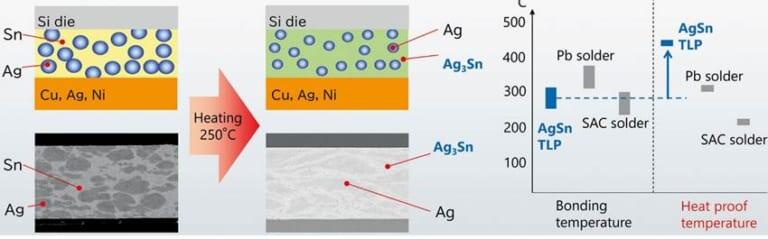
Semiconductor devices, including power semiconductors, require high heat resistance to prevent failures and shortened lifespans due to high temperatures. Currently, high-lead solder, which is being replaced from the perspective of environmental impact, is mainly used as a bonding material in the manufacture of power semiconductor packages. Although lead is subject to restrictions under the RoHS Directive, its use is permitted within the validity period for applications where scientific and technological alternatives are difficult. However, as the current validity period is being excluded, the development of alternative materials is underway. Other materials used include SAC solder (solder material containing tin, silver, and copper) with lower heat resistance and silver (Ag) sintering materials. The heating temperature of this product is 250°C, allowing for transient liquid phase diffusion bonding. Transient liquid phase diffusion bonding (also known as TLP bonding) is a method of diffusion bonding in which a metal inserted at the bonding interface is temporarily melted and liquefied, and then bonding is performed through isothermal solidification using diffusion. The heat resistance after bonding reaches 480°C, exceeding that of conventional products. In addition, it can maintain bonding strengths of up to 50 MPa, allowing it to be used with various bonded materials. Furthermore, this product is a lead-free bonding material and has high bonding reliability, having passed thermal cycle tests for 3,000 cycles.
Since this product allows large-area bonding, in addition to its use as a die bonding material for power semiconductors, it is also expected to be used as a TIM substitute. Various materials with high thermal conductivity have been developed for use in semiconductor package manufacturing, but the low thermal conductivity of TIM has been an issue in thermal design as a whole. Furthermore, this product is a high thermal conductivity bonding material that enables the bonding of TIM with an area exceeding 50 mm, and it is expected to contribute to thermal management in semiconductor package manufacturing.
To see our latest posts, please see "Hub for Power Electronics" in PCIM Magazine, published by PCIM.

URL: https://pcim.mesago.com/nuernberg/en/pcim-insights/pcim-magazine.html
How was this article?
If you found this helpful, please share it.


