

Probe Pin Materials
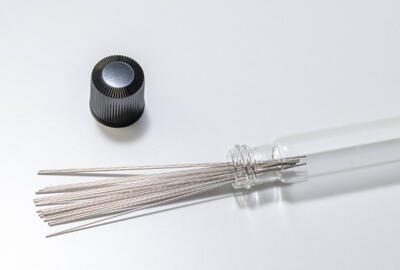
What is "Probe Pin Material"?
These micro-contact parts are used in electrical property testing (wafer testing and final testing) of semiconductors and electronic components, and require high contact stability and durability. TANAKA uses its own proprietary high-performance precious metal alloys, such as Pd-Ag-Cu, Pd-Ag-Au-Pt-Cu, and high-hardness Pd alloys, and offers wires in sizes from Φ20 to 1,000µm, as well as Pd-Ag-Cu and Cu alloy sheet materials.
Precious metal-based Probe Pin material used in the inspection process of semiconductor manufacturing.
We offer a wide range of precious metal materials for probe pins used in inspections carried out during the front-end and back-end of semiconductor manufacturing.
Uses of Probe Pin Materials
Semiconductor integrated circuits are subjected to current-carrying tests at each of the front-end and back-end processes of the manufacturing process.
The electrical test conducted in the process before production is called wafer test, and probe cards are used. Probe cards use probe pins of different types, such as cantilever-type and vertical-type, as probes.
The current-carrying test in the front-end process is called a wafer test, and a probe card is used. Probe cards use cantilever or vertical probe pins. The current-carrying test performed in the back-end process is called the final test, and a test socket is used. Pogo pin type probe pins are used for the test sockets.
We offer a lineup of various probe pin materials, as the performance required in terms of mechanical properties such as hardness and bendability, and electrical properties such as electrical resistivity, etc., vary depending on the application.
![[Diagram of the Applications of Probe Pin Materials] (Before Process) Wafer Test—Cantilever-type/Vertical-type, (After Process) Final Test—Pogo Pin-type](https://data.wovn.io/ImageValue/production/688b3c307ffdea2de8055986/en/e9244f9d242e45d4135a91d79603f270/wp_content_uploads_sites_images_ex_en_products_images_probe_pins_img_block01_01.jpg)
Types and Features of Probe Pins
Cantilever-type
- Features: Used in Probe Cards with terminal structures that operate on the principle of cantilever beams for testing wiring substrates. The tip of the Probe Pin is needle-shaped and is used after being subjected to tapering and bending.
- Material requirements: Material hardness, linearity, electrical resistivity, bendability, etc.
- Wire diameter: Φ50 to 300µm
Vertical-type
- Features: These are used for probe cards for testing wiring boards with a terminal structure that works on the principle of buckling stress. The tip of the probe pin is processed into a needle or hemispherical shape, depending on the board.
- Material requirements: Material hardness, linearity, electrical resistivity, bendability, etc.
- Wire diameter: Φ20 to 70µm
Pogo Pin Type
- Features: These are also called spring probes or contact probes. They are used for electric current inspection of ICs, electronic components, and printed circuit boards. The tip is processed into a shape that corresponds to the object to be inspected.
- Material requirements: Material hardness, linearity, contact resistance, etc.
- Wire diameter: Φ500µm to 1,000µm
Major Materials for Probe Pins
| SP-1 | SP-2 | TK-1Pro | TK-FS | TK-SK | Rh | Ir | ||
|---|---|---|---|---|---|---|---|---|
| Composition (mass%) |
Pd | 35 | – | 40 | 55.8 | 48.9 | – | – |
| Ag | 30 | 10 | 29.5 | 6.9 | 19.25 | – | – | |
| Au | 10 | 70 | – | – | – | – | – | |
| Pt | 10 | 5 | – | – | – | – | – | |
| Others | Cu, Zn | Cu, Ni | Cu, etc. | Cu, etc. | Cu, etc. | Rh | Ir | |
| Wire diameter range (mm) | 0.08-1.00 | 0.08-1.00 | 0.10-1.00 | 0.03-0.40 | 0.50-0.80 | 0.03-0.30 | 0.03-0.30 | |
| Electrical resistivity |
25.0 | 13.3 | 11.0 | 6.1-6.9 | 16.1 | 4.8 | 5.6 | |
| Electrical conductivity (%IACS) | 6.9 | 13.0 | 15.7 | 25.0-28.3 | 10.7 | 35.9 | 30.8 | |
| Temperature coefficient of resistance (ppm) | 299 | 420 | – | 1346 | – | 4500 | 3900 | |
| Vickers hardness (HV) | 300-350 | 300-360 | 500-540 | 400-520 | 600-640 | 400-550 | 500-750 | |
| Tensile strength (MPa) | 1210- 1450 |
1210- 1350 |
1800- 2000 |
1250- 1720 |
– | 1400- 1800 |
1700- | |
| Elongation at failure (%) | 1-2 | 1-2 | 2-3 | 10-25 | 0-1 | 1-2 | 1-2 | |
| Young's modulus (GPa) | 112 | 106 | 110 | 150 | 119 | 380 | 530 | |
| 0.2% proof stress/RD (MPa) | 1160- 1400 |
1100- 1250 |
– | 1180- 1640 |
– | -1700 | -3400 | |
| Elastic limit (MPa) | 1110- 1170 |
1050- 1100 |
– | 1000- 1500 |
– | -1350 | -2900 | |
| Elongation at elastic limit (%) | 0.9-1.3 | 0.8-1.0 | – | 0.8-1.1 | 0-1.0 | 0.3-0.6 | 0.4-0.6 | |
| |
3-6 | 3-6 | 0-2 | 10-14 | – | – | – | |
| Remarks | *2 | – | – | *3 | *3 | *3 | *3 | |
*1: Number of repeated bending tests until faliure with a wire diameter of 0.10 mm (according to in-house standard)
*2: Equivalent to ASTM B540
*3: Product covered by our patents
The above is an example, and we can accommodate compositions not listed, so please contact us for more information.
*The above are the property values for wire materials. The property values differ between wire and sheet materials.
*Sheet materials can be supplied for TK-FS and SP-1. For details, please refer to “Sheet material for vertical probe pins” at the bottom of this page.
Standard material: TK-1Pro
Standard Material for Pogo Pin-Type Products Provided by TANAKA
Applications
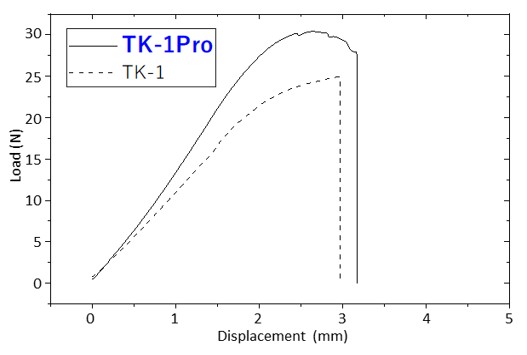
Designed for pogo pin-type plunger components, this material improves machinability while preserving the stable contact resistance performance of conventional TK-1.
Features
- Improved the mechanical properties of conventional TK-1
- Hardness increased by about 10% from conventional TK-1
- Furthermore, improved toughness contributes to improved machinability during cutting processing
Comparison of Three-Point Bending Characteristics of TK-1Pro and TK-1
Development Material: TK-FS
Achieves low electrical resistivity, high bendability, and a wide hardness range all at the same time.
There was no material in our existing products that could simultaneously achieve the three qualities of high hardness, low electrical resistivity, and high bendability, but we have succeeded in solving this problem with this product, making it possible to use the same material for various types of probe pins. This material can be applied to a wide range of probe pin types, such as the cantilever type and the vertical type for wafer testing (front-end process) probe cards.
Features
- Simultaneously achieves three functions: Vickers hardness of 500 or higher, electrical resistivity of 7.0 µΩ・cm or lower, and repeated bending durability (according to our standards) of 10 times or more.
- Our unique processing technology enables adjustment to a wide range of Vickers hardness (400 to 520).
- Higher elongation (10% to 25%) than TANAKA PRECIOUS METAL TECHNOLOGIES’ existing probe pin materials.
Performance of TK-FS (Comparison with Major Probe Pin Materials)
Vickers Hardness vs Electrical Conductivity
![[Comparison of Material Properties (Hardness/Electrical Conductivity) for Probe Pins]TK-FS and others](https://data.wovn.io/ImageValue/production/688b3c307ffdea2de8055986/en/e40d7e92405496b4c05669f6a35a7eec/wp_content_uploads_sites_images_ex_en_products_images_probe_pins_img_block04_01.jpg)
Elongation at Failure
![[Comparison of Material Properties for Probe Pins (Elongation)] by TK-FS and others](https://data.wovn.io/ImageValue/production/688b3c307ffdea2de8055986/en/d89fd6b1b48426e42ecb91d54ba03cc0/wp_content_uploads_sites_images_ex_en_products_images_probe_pins_img_block04_02.jpg)
Features of TK-FS (High Bending Durability)
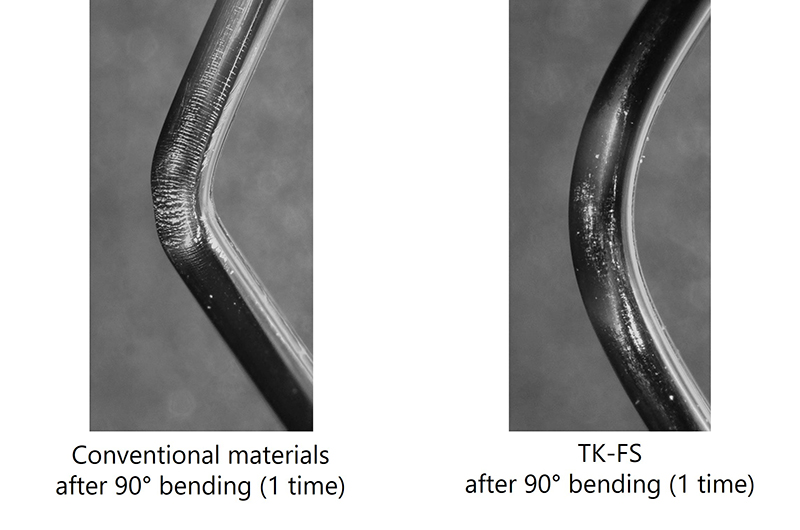
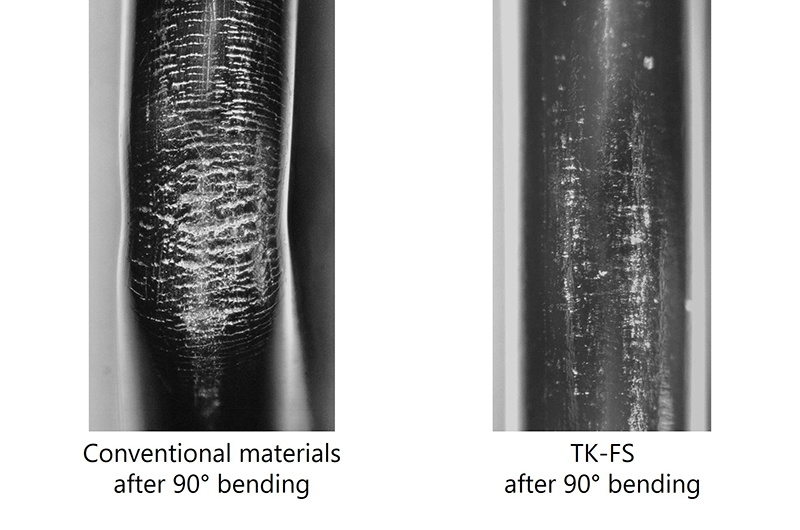
Schematic diagram of repeated 90° Bending Test
Developed material: TK-SK
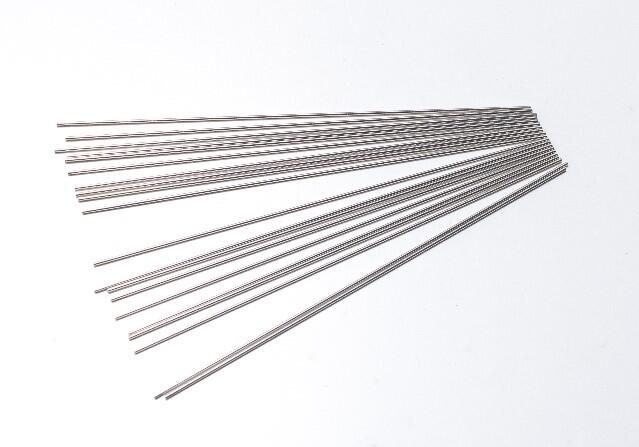
Achieves a hardness of 640 HV as a palladium alloy material.
In semiconductor testing equipment, this product helps reduce deformation of Probe Pins due to wear, contributing to longer service life and lower costs of testing equipment.
Applications
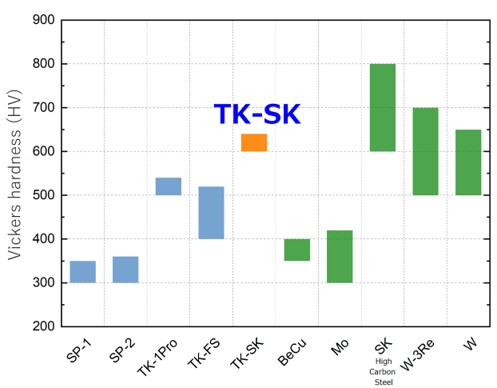
As a palladium alloy for probe pins, TK-SK exhibits maximum hardness of 640HV that makes it suitable for use in test socket applications mainly in the final continuity testing stage (back-end process).
Features
Pogo pin-type Probe Pins are used as probes in test sockets. During inspection, the tip (plunger) of the Probe Pin deforms due to wear as friction occurs when it comes into contact with the substrate. In addition, solder material may adhere to the plunger, and solder material must be scraped off for cleaning. The plunger also deforms due to wear during this process.
High-hardness probe pins, like TK-SK, reduce wear-related deformation, leading to longer service life and lower maintenance costs for semiconductor test equipment.
Properties (Reference Values)
| Physical Properties | Reference values |
|---|---|
| Wire diameter range (mm) | 0.50-0.80 |
| Melting point (℃) | 997℃ |
| Density (g/cm3) | 10.52 |
| Vickers hardness (HV) | 640 |
| Electrical resistivity (µΩ·cm) | 16.1 |
| Electrical conductivity (%IACS) | 10.7 |
Hardness comparison between TANAKA probe pin materials and non-precious metal high hardness materials
Sheet material for vertical probe pins
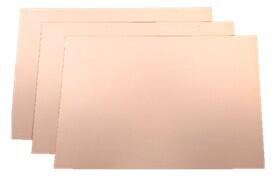
Provides various types of precious metal sheets materials.
Minimum thickness of 30µm has been achieved, keeping pace with the ongoing miniaturization of components trend.
For vertical probe pins, we can provide TK-FS, SP-1, and TK-101 sheet materials.
Characteristics
| TK-FS (Pd-Ag-Cu) |
SP-1 (Pd-Ag-Au-Pt-Cu) |
TK-101 (Cu-Ag) |
||
|---|---|---|---|---|
| Density (g/cm3) | 10.49 | 11.90 | 9.07 | |
| Melting point (℃) | 1,100 | 1,098 | 780 (Solidus) | |
| Electrical resistivity at R.T. (µΩ・cm) |
As-Rolled | – | 25.2 | 2.5 |
| As-Aged | 6* | – | – | |
| Vickers hardness (HV) |
As-Rolled | – | 300 | 330 |
| As-Aged | 400-420* | – | – | |
| Tensile strength (MPa) | 1,200* | 1,100 | 1,000 | |
| Young's modulus (GPa) | 110* | 110 | 105 | |
| 0.2% proof stress/RD (MPa) | 1,150* | – | 900 | |
*TK-FS sheet is under development and the property values are only for reference.
Available sheet sizes
| TK-FS (Pd-Ag-Cu) |
SP-1 (Pd-Ag-Au-Pt-Cu) |
TK-101 (Cu-Ag) |
|
|---|---|---|---|
| Thickness (mm) | 0.10 | 0.05 | 0.20~0.03 |
| Width (mm) | 55 | 62 | 100 |
| Length (mm) | 50~330 | 50~300 | 50~330 |
Warp and waviness shall be acceptable for sample products. Conditions can be discussed upon the customer’s requests.
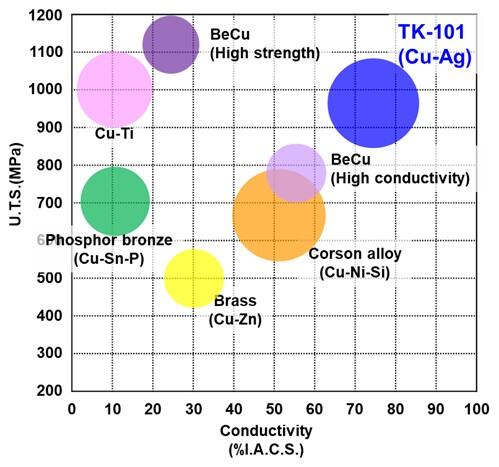
Comparison of Copper Alloy Sheet properties for Probe Pins (Electrical Conductivity/U.T.S. at 20℃)
Related Information

First, please make an Inquiry about the product.
For any questions regarding product specifications, pricing, delivery times, etc., please feel free to Inquiry here.