

TANAKA PRECIOUS METAL TECHNOLOGIES's Challenges: Strategies for Rapid Expansion in the Automotive and Semiconductor Sectors (2) The Strength of Precious Metals for Automotive Applications
February 25, 2021 Electronic Device Industry News
When one thinks of TANAKA, one immediately thinks of gold bullion and precious metal jewelry. Perhaps more than any other dream, a ring made of gold has a value that can almost be said to be absolute. TANAKA, which has a history of 135 years dealing with gold and other precious metals, shifted its focus to the industrial use of precious metals alongside Japan's industrialization. It has developed platinum industrial products, including platinum wire and platinum gauze for catalysts, and has supported the industrialization of modern Japan.
Today, TANAKA has grown into a company with total sales of approximately ¥1 trillion across the Group. Although this figure includes bullion, which is the raw material, it is a company of this scale. However, it is important to note that, by far, there is a greater handling of industrial products than of bullion trading, which is more commonly known to the general public. At this stage, it can be said that approximately 70% of total sales are related to materials for industrial use.
The automotive industry is undoubtedly the world's largest industry. Including related industries from manufacturing to services, it has created a market worth ¥400 trillion worldwide. By the way, with Toyota regaining the top spot in the world rankings for the first time in several years, global automotive users are likely to have reinforced the impression that Toyota is indeed strong among Japanese automakers.
"TANAKA has a wealth of technologies that are truly golden when it comes to various materials for automobiles. Precious metals, with gold as a representative, are often the first materials considered during technological innovation, and many developments have been made using them. Depending on the required characteristics and functions, platinum and silver have also been actively used. Precious metals are indeed highly durable materials with exceptionally superior characteristics. Even in the world of automobiles, TANAKA's products are expected to continue to play an active role in the future."
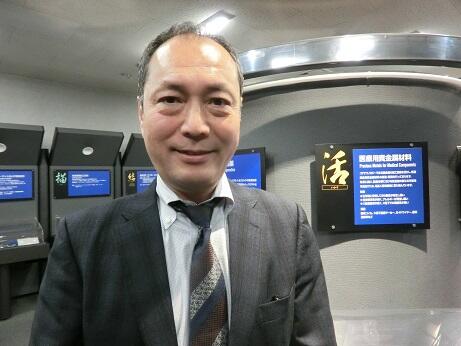
These are the words of Mr. Noriaki Hara, who is the head of the Marketing Department of the New Business Company of TANAKA PRECIOUS METAL TECHNOLOGIES. Mr. Hara is from Kofu City, Yamanashi Prefecture, studied at the Department of Chemistry, Faculty of Science, Tokyo University of Science, graduated from the Graduate School of Engineering at Yamanashi University, and joined TANAKA PRECIOUS METAL TECHNOLOGIES. He also holds a Doctor of Engineering. Incidentally, the title of his graduation thesis was "Study on Direct Gas Phase Synthesis of Ammonia."
Various types of relays are widely used in various fields.
TANAKA' materials are used in a huge number in automobile drive systems. The number of so-called contacts is extremely large. Contacts in accelerator position sensors, brake position sensors, steering heaters, electric power steering, etc. are made from materials such as gold, silver, and copper. PGM materials such as platinum are also widely used in spark plugs and injectors. They are also active in the field of engine temperature sensors (reed switches).
TANAKA' products are also highly effective in automotive electronic devices. ECUs use a wide variety of pastes and wires. Aluminum ribbon is required for the cooling fins on the heat sinks of IGBTs. Aluminum wire is used in hybrid ICs for AC/DC converters. Inverters require gold wire in addition to aluminum and copper. TANAKA has cultivated the processing of precious metals such as platinum, gold, and silver as its core technology, but in response to market demands, it is also expanding its products to include base metals such as copper and aluminum for applications where its core technology can be applied.
"When it comes to materials and parts for automobiles, we have to tackle the contradictory challenge of reducing the amount of precious metals used while maintaining high quality. This is due to customer requests. While there is a demand for less precious metals, reliability is extremely important in the automobile industry, so it is clear that we cannot completely eliminate precious metal materials that meet the requirements of high durability and high reliability.
There are many requests for customization, and we must respond to these in an accurate manner," said Hara.
The automotive industry is paying close attention to environmental measures, which have become a global issue. Exhaust gas purification has also become an important issue, and we provide compounds for exhaust gas purification catalysts and also recycle precious metals from used automobile purification catalysts.
TANAKA 's precious metal materials are used throughout sensing components that contribute to improved fuel efficiency and environmental friendliness, such as exhaust temperature sensors,O2sensors, NOx sensors, PM sensors, exhaust gas recirculation sensors, and valve sensors.
Next-Generation Cars Will Also Use Gold and Silver
“For next-generation vehicles, gold and aluminum wire are used in CMOS vehicle cameras, while silver paste is used in antennas. A typical hybrid vehicle has around 33,000 components, and this number is expected to continue to grow. In the cockpit, LED display elements and driver ICs for displays are important devices, and here too, gold-based plating, wires, and paste from TANAKA are essential materials” (Hara).
For EVs, which are experiencing a global boom, aluminum wire is also an essential material for lithium-ion batteries, and here too, TANAKA's products are playing an important role. As the trend of next-generation vehicles emerges, the variety of TANAKA's products for vehicles is expected to continue to expand.
(Special Editorial Committee Member Wataru Izumiya)
Related Information

How was this article?
If you found this helpful, please share it.


