

Tears of wine and palladium-coated copper wire: Marangoni effect

Semiconductor Digest, March 2024
DODGIE CALPITO, YUMI SHIMADA TANAKA Kikinzoku International (America), Inc.
TAKESHI KUWAHARA TANAKA ELECTRONICS CO., LTD. (Japan)
In conventional palladium-coated copper wires, the mixing of palladium and copper is explained by the Marangoni effect. Unique impurities can counteract this effect.
Wine tears
As shown in Figure 1, wine tears are transparent liquid that forms inside a glass when wine is poured and drips down. This occurs due to differences in surface tension, with moisture flowing away from evaporating alcohol. Water, which has high surface tension, rises along the walls of the glass, separating from the alcohol-water mixture in the wine due to capillary action. This phenomenon is known as the Marangoni effect, named after the physicist Carlo Giuseppe Matteo Marangoni, who studied the reaction of oil on water in the 1860s. Figure 2 shows an example of this effect in mixed materials when heat is applied.
The mechanism by which Free Air Ball (FAB) is generated during ultrasonic thermocompression wire bonding, the most common method for interconnecting semiconductors, is thought to be the Marangoni effect. FAB is a spherical end of a wire melted by discharge and forms the first bond of interconnection when pressed and ultrasonically welded to a device.

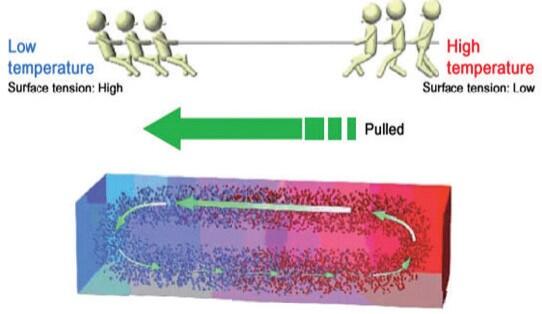
Source: https://iss.jaxa.jp/kiboexp/theme/first/marangoni/haikei.html
Related Information

How was this article?
If you found this helpful, please share it.


