

Technical Feature: Innovations in Power Electronics — Silver Adhesives Supporting the Reliability and Thermal Performance of Next-Generation Semiconductors
Source: Power Systems Design (PSD)
Date: February 19, 2026
Author: Makoto Fushimi, SEC Manager, Bonding Materials Sales, Product Sales Department, Sales Division, TANAKA PRECIOUS METAL TECHNOLOGIES CO., LTD.
Link: Revolutionizing Power Electronics: Silver Adhesive Pastes for Next-Gen Semiconductor Reliability and Thermal Performance
As power electronics evolve with the rise of wide-bandgap semiconductors like silicon carbide (SiC) and gallium nitride (GaN), the demand for advanced die bonding solutions becomes increasingly critical. Die bonding solutions enable power systems that operate at significantly higher switching frequencies, deliver higher power densities, and withstand extreme temperatures compared to traditional silicon-based devices. As a result, they are fueling rapid advancements across electric vehicles (EVs), renewable energy systems, industrial automation, aerospace, and power conversion technologies.
However, these performance gains also place tremendous new demands on device packaging. As switching speeds rise and heat densities increase, packaging materials must reliably dissipate heat and absorb mechanical stress without degrading over time. Traditional die-bonding materials, particularly high-temperature lead-based solders and conventional conductive silver pastes are struggling to keep up.
These older materials often lack the elasticity, thermal conductivity, or long-term mechanical stability needed to support SiC and GaN devices operating above 200°C. Cracking, delamination, and thermal fatigue become more severe as thermal cycling intensifies, creating reliability challenges that threaten system performance in mission-critical applications.
This mismatch between device capability and packaging durability has accelerated the industry’s search for advanced materials that can sustain high thermal loads while maintaining long-term mechanical integrity. That’s where silver adhesives pastes come in, offering a fundamentally new approach to bonding high-performance dies to substrates.
Silver Adhesive Paste : A Next-Generation Die Bonding Solution
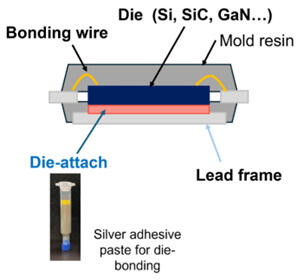
Silver adhesive pastes are emerging as a superior bonding alternative for high-temperature and high-power applications because they offer a combination of high thermal conductivity, strong electrical performance, and mechanical elasticity; a balance previous bonding materials have been unable to achieve.
These pastes create a low-resistance thermal path that dissipates heat more efficiently than many traditional bonding agents. At the same time, their viscoelastic properties allow them to absorb mechanical stress caused by thermal expansion mismatch between dies and substrates. Importantly, silver adhesive pastes process at lower temperatures than solder-based methods, typically below 200°C, reducing thermal stress during assembly and enabling compatibility with temperature-sensitive semiconductor structures.
Advancing Performance Through Hybrid Sintering Materials
To meet increasingly stringent reliability requirements, engineers have developed a hybrid sintering silver paste that incorporates a special resin directly into the sintered silver network. Conventional sintered silver offers extraordinary thermal conductivity, but its firmness makes it vulnerable to delaminate especially under repeated thermal cycling. Resin-based adhesives, conversely, offer flexibility but lack sufficient heat dissipation for high-power applications.
The hybrid sintering approach delivers metallic silver pathways for superior heat dissipation, resin reinforcement for elasticity and stress absorption, improved adhesion strength to prevent die lift, and resistance to delamination during high-temperature cycling. Over time, this combination dramatically reduces fatigue-induced failure, making hybrid pastes ideal for SiC and GaN devices that experience continuous temperature fluctuations and extreme load cycles.
Enabling High-Temperature and High-Power Applications
As industries adopt SiC and GaN devices to unlock higher efficiency and compact system designs, bonding materials must handle more intense thermal and mechanical loads.
SiC-based inverters and onboard chargers operate at high temperatures under constant vibration and thermal cycling. Silver adhesive pastes strengthen thermal pathways and enhance adhesion, improving system stability and reducing inverter failures.
Industrial Automation and Motor Drives: In industrial settings, motor drives and robotics systems operate for extended periods in high-temperature environments, often under constant or repetitive load. Silver adhesive pastes contribute to compact and efficient designs by maintaining strong adhesion and stable thermal performance even when devices are pushed to their limits. Their ability to maintain structural integrity over millions of power cycles ensures that industrial systems remain stable, reducing disruption and allowing for predictive maintenance strategies.
Renewable Energy: Solar and wind power applications introduce unique thermal challenges: solar inverters experience temperature spikes during peak sunlight hours, while wind turbine power converters must perform in cold, high-vibration environments. Silver adhesive pastes ensure stable electrical and thermal interfaces, preventing performance degradation caused by weather-related temperature cycling. Their high thermal conductivity improves overall system efficiency, while their elasticity protects against delamination in fluctuating outdoor conditions.
Aerospace and Defense: Aerospace and defense systems push power electronics into some of the harshest environments, from extreme altitude temperature swings to intense vibration during liftoff or maneuvering. The mechanical toughness and high-temperature capability of silver adhesive pastes provide a strong advantage here. Their ability to maintain bond-line integrity under severe mechanical and thermal stresses helps ensure mission-critical reliability.
A Foundation for the Future of Power Devices
As the global demand for high-performance semiconductors continues to grow, the materials used to bond, package, and protect them must evolve to keep pace. Silver adhesive pastes, particularly hybrid sintering formulations, offer a compelling solution that addresses the thermal, mechanical, and environmental challenges facing next-generation power electronics.
By combining exceptional thermal conductivity, mechanical stress absorption, high-temperature durability, and lead-free sustainability, silver adhesive pastes lay the groundwork for more reliable, efficient, and responsible power systems.
With innovations in materials science accelerating and WBG semiconductors becoming the industry standard, adhesive technologies like these will not only support but enable the next wave of electrification and high-performance power device design.
This article was reprinted from an article published in “Power System Design” on February 19, 2026, with permission from Power System Design. This article was translated by TANAKA from Power System Design with their permission.
This article was published on Power System Design. Further information can be found here:
Learn more... (Power System Design)
Related Information

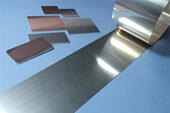
Technology Trend and Advanced Packaging Material for Power Device
Power device is key component for a wide range of applications such as smartphones, electronic devices, next-generation mobility including EV and HEV, cellular base stations, power control for renewable energy and so on. Its technology development is thriving day by day.
We introduce advanced packaging technology trends and cutting-edge materials designed to address challenges such as high heat dissipation, high heat resistance, reliable bonding in manufacturing, and miniaturization.

How was this article?
If you found this helpful, please share it.


