

TANAKA PRECIOUS METAL TECHNOLOGIES's Hybrid Sintering Reassesses the Reliability of SiC/GaN Power Modules
Source: Semiconductor Digest
Date: December 12, 2025
Link: https://www.semiconductor-digest.com/tanakas-hybrid-silver-adhesive-paste-redefines-reliability-for-sic-gan-power-modules/
Shintaro Abe, Global R&D Senior Manager of Silver Adhesives TANAKA PRECIOUS METAL TECHNOLOGIES CO., LTD., explains the breakthrough in materials that has made high-temperature, pressureless die attach possible.
As wide bandgap (WBG) semiconductors have become mainstream in power electronics, the reliability of packaging has become one of the major challenges. The die attachment layer is subjected to extreme thermal, mechanical, and chemical stress at temperatures exceeding 200°C for SiC MOSFETs and GaN HEMTs. This is under harsh conditions that exceed the limits of conventional materials such as solder and epoxy-based adhesives.
TANAKA PRECIOUS METAL TECHNOLOGIES CO., LTD. has developed a hybrid sintering technology that achieves high thermal conductivity, strong bonding at temperatures above 200°C, pressureless processing, and long-term fatigue resistance. According to Shintaro Abe, Senior Manager of the R&D Department at TANAKA PRECIOUS METAL TECHNOLOGIES, the company established this innovative joining technology by simultaneously solving two challenges: achieving silver sintering in resin and controlling the resin distribution within the sintering network.

According to Abe, the first major leap was the ability to sinter silver particles in an environment where resin is present. This is an environment where sintering would normally be inhibited. "Sintering silver in resin is usually difficult because resin inhibits the sintering process. We overcame this challenge by using our unique design technology to optimize the interfacial interaction between silver and resin while maintaining the sinterability of silver," says Abe.
The second leap was related to engineering and microstructures. Abe explained, “By allowing resin to be unevenly distributed within the sintered silver structure, we have made it possible to achieve both thermal conductivity and mechanical flexibility. Instead of uniformly dispersing the resin, we have selectively positioned it as a matrix within the silver sintering network.”
By placing resin only where necessary, TANAKA PRECIOUS METAL TECHNOLOGIES has developed a composite material that significantly reduces elastic modulus while maintaining high thermal conductivity. "These two innovations have allowed us to maintain high thermal conductivity while adding mechanical flexibility and ensuring long-term reliability. Conventional resin-based adhesives have significantly reduced bonding strength when the temperature exceeds 200°C, so bonding and sintering had to be combined," explains Abe.
Reliability at high temperatures is the most important issue for WBG power modules. Silver adhesives based on conventional resins have unstable bonding at high temperatures. Mr. Abe explains the mechanism behind this problem as follows: "At high temperatures above 200°C, the performance of adhesive systems that rely on hydrogen bonding deteriorates, and shear strength significantly decreases."
To address this issue, TANAKA PRECIOUS METAL TECHNOLOGIES has developed a silver sintering technology that combines the chemical properties of silver bonding. “We have combined sintering and bonding technologies. This maintains high bond strength even in environments exceeding 200°C and effectively disperses stress during temperature cycles that is caused by differences in the linear expansion of the bonding material.”
The substance obtained from this result forms a stable structure that alleviates thermomechanical fatigue, particularly in copper and ceramic-based power substrates.
Management of voids
Voids, especially in high-output modules, can reduce electrical conductivity and reliability. Mr. Abe explained the company's strategy as follows: "First, we fill the silver filler with high density. By combining silver particles of different sizes and shapes, we form a structure with high density. After sintering, the resin melts and fills the minute voids, resulting in a structure with even higher density and stability." This effectively prevents the intrusion of oxygen and moisture. "By minimizing voids, we can prevent the intrusion of oxygen and moisture, which can cause long-term deterioration," Mr. Abe said.
Sintering without pressure
A major advantage is its high compatibility with existing die attachment processes. Mr. Abe states, "Pressurized sintering requires dedicated equipment, but our hybrid sintering can be processed without pressurization using the heating systems of existing batch-type ovens. This allows our customers to easily introduce new materials without making significant changes to their production lines."
The same adhesive can be used in a press system.
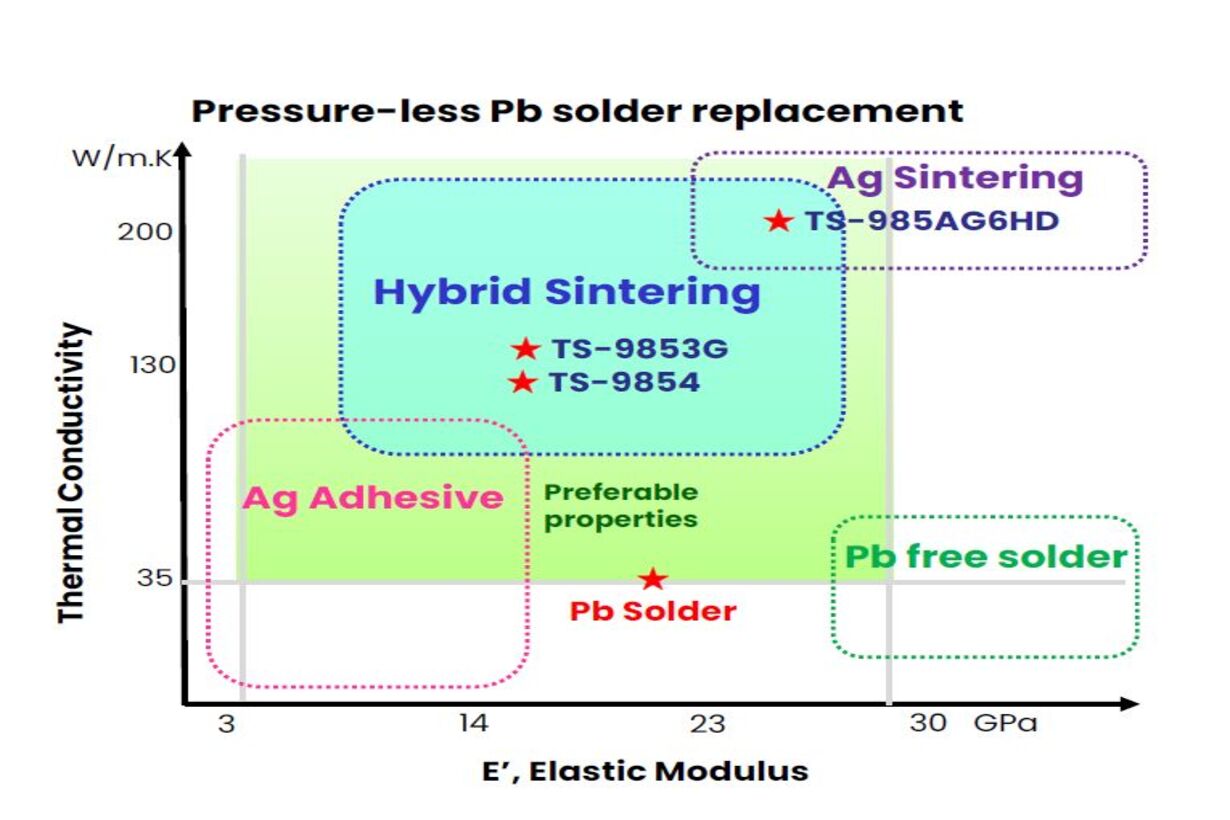
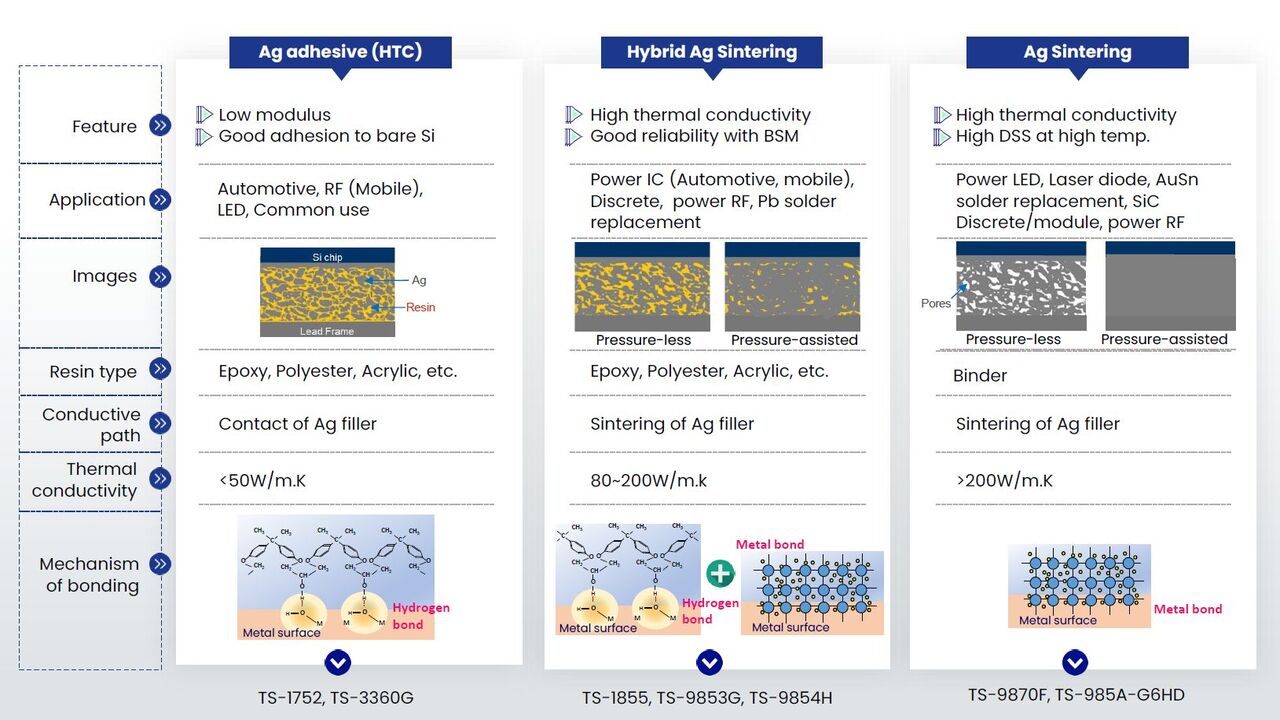
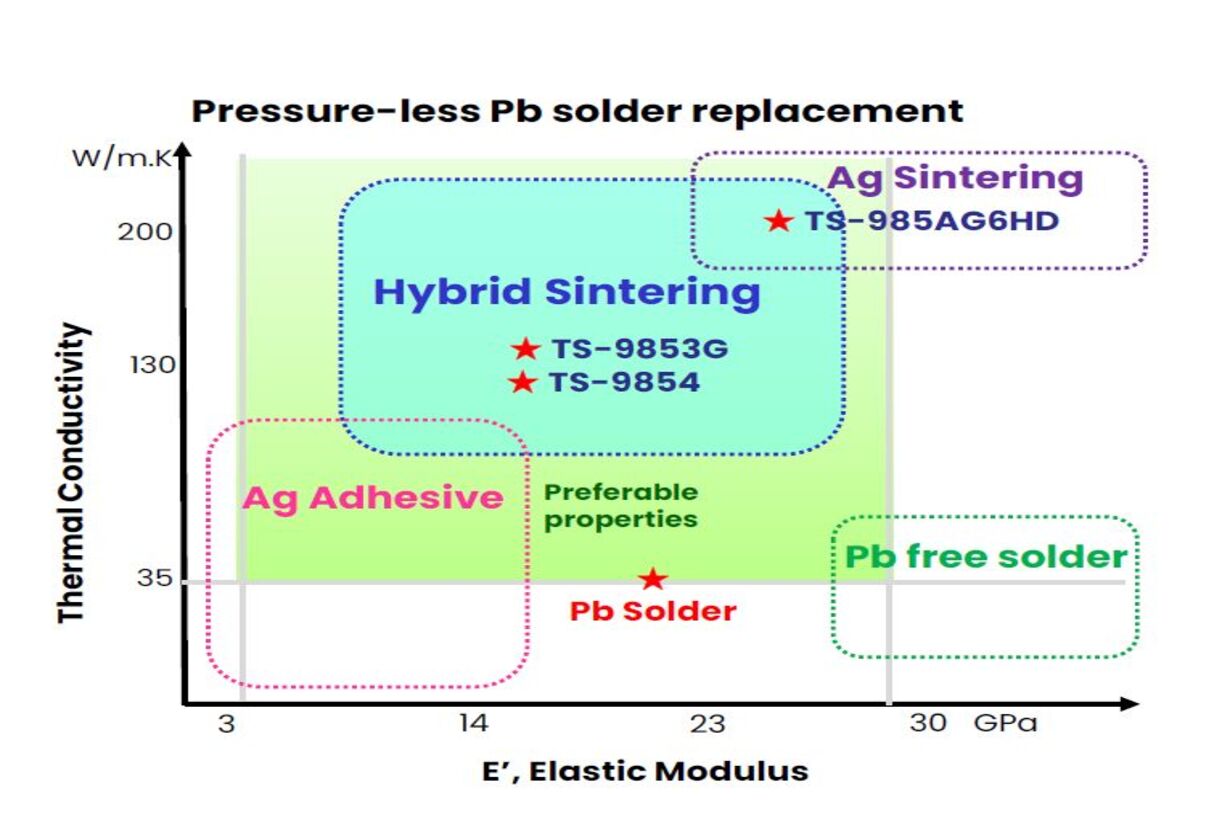
Figure 1 shows the lineup of silver die attachment products by TANAKA PRECIOUS METAL TECHNOLOGIES, with a new hybrid sintering in the center. Figure 2 compares hybrid sintering with other products.
Substrate Compatibility
Bare copper is one of the most difficult materials to bond because the formation of a thin oxide film hinders metal bonding. Abe states, "Since bare copper is the most difficult material to bond, we are focusing our efforts there. Our process has high compatibility with bare copper."
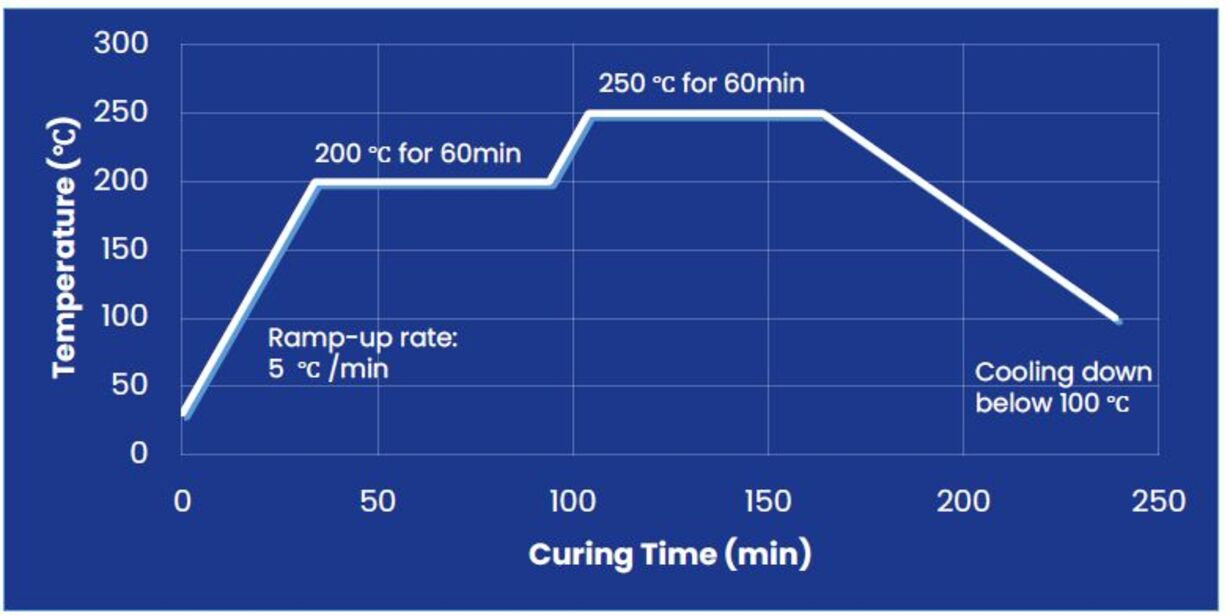
Figure 3 shows the recommended hardening profile optimized for bare copper. This profile is also suitable for silver and gold. For silver and gold, reliable bonding can be achieved even at low temperatures of around 200°C.
Fortunately, TANAKA PRECIOUS METAL TECHNOLOGIES already has the necessary infrastructure in place at its factories. “Our manufacturing plants have extensive experience in producing various types of paste materials. This has allowed us to smoothly transition from prototyping to mass production without significant capital investment.”
In addition to its technical capabilities, TANAKA PRECIOUS METAL TECHNOLOGIES Kogyo has established a circular supply chain. By focusing on recovering and refining precious metals from industrial scrap, the company has established environmentally conscious initiatives to reduce its environmental impact and ensure the sustainable and efficient use of precious metals. Circular procurement not only has environmental benefits, but also plays a strategically important role in ensuring a stable supply of precious metals. Especially for raw materials with limited production volumes and robust procurement capabilities, recycling increases supply stability while also contributing to reducing carbon dioxide emissions and establishing a more sustainable production system. A key Features of this approach is that products are made from raw materials refined from recycled precious metals, utilizing the advanced recycling and precious metal analysis technologies that TANAKA PRECIOUS METAL GROUP has cultivated over many years. Furthermore, the company can provide products and solutions made from 100% recycled precious metals upon customer request. "A circular economy and sustainable raw material supply are extremely important to our customers. Our recycling system and procurement capabilities are a major competitive advantage," says Abe. Furthermore, the hybrid paste is completely lead- and PFAS-free.
In addition, TANAKA PRECIOUS METAL TECHNOLOGIES provides a one-stop service for precious metal materials, from bullion procurement to processing, manufacturing, sales, and recycling.
Future Direction
As packaging evolves into thin die and advanced multilayer structures, TANAKA PRECIOUS METAL TECHNOLOGIES is developing next-generation adhesives. Mr. Abe explains the roadmap as follows: "Some customers are aiming for die thickness of less than 50 micrometers. Paste materials tend to creep on the surface of chips during the bonding process, and this phenomenon becomes particularly pronounced as chips become thinner. Overcoming this challenge is an important theme for next-generation packaging."
Cost reduction in both materials and manufacturing processes is also a key theme. "Next-generation demand is expected to be extremely complex, so it is necessary to carefully monitor technological trends and reduce costs in both materials and processes."
To address these issues, TANAKA PRECIOUS METAL TECHNOLOGIES is developing bonding technologies suitable for thin-film chips. In addition, while maintaining thermal and mechanical properties, the Company is also working to reduce costs by reducing the amount of precious metals used. “We are collaborating with our customers and research institutions in Europe for next-generation packaging.”
HYBRID SINTERING by TANAKA PRECIOUS METAL TECHNOLOGIES is not just a new bonding material. It signifies a transformation in the industry's approach to the long-standing trade-off between thermal performance and mechanical durability. By enabling sintering in resin structures, optimizing particle filling, and allowing sintering without applied pressure, this material directly addresses the needs of SiC/GaN power modules entering the mass production market.
“Our hybrid sintering adhesive sufficiently meets the requirements of next-generation power electronics, where long-term reliability and thermal efficiency are essential. Using the expertise on materials that we have developed over several decades, we will continue to contribute to innovations in semiconductors,” Abe concluded.
Related Information
Semiconductor Fabrication and TANAKA
Since its establishment in 1885,TANAKA has advanced hand-in-hand with Japan’s manufacturing industry as a specialist in precious metals.


Technology Trend and Advanced Packaging Material for Power Device
Power device is key component for a wide range of applications such as smartphones, electronic devices, next-generation mobility including EV and HEV, cellular base stations, power control for renewable energy and so on. Its technology development is thriving day by day.
We introduce advanced packaging technology trends and cutting-edge materials designed to address challenges such as high heat dissipation, high heat resistance, reliable bonding in manufacturing, and miniaturization.
How was this article?
If you found this helpful, please share it.


