

【First-time Exhibitor at SEMICON India 2025】TANAKA to Make Inroads into Semiconductor Business with In-Depth Knowledge of Precious Metals! Supporting the Reliability of Bonding and Testing
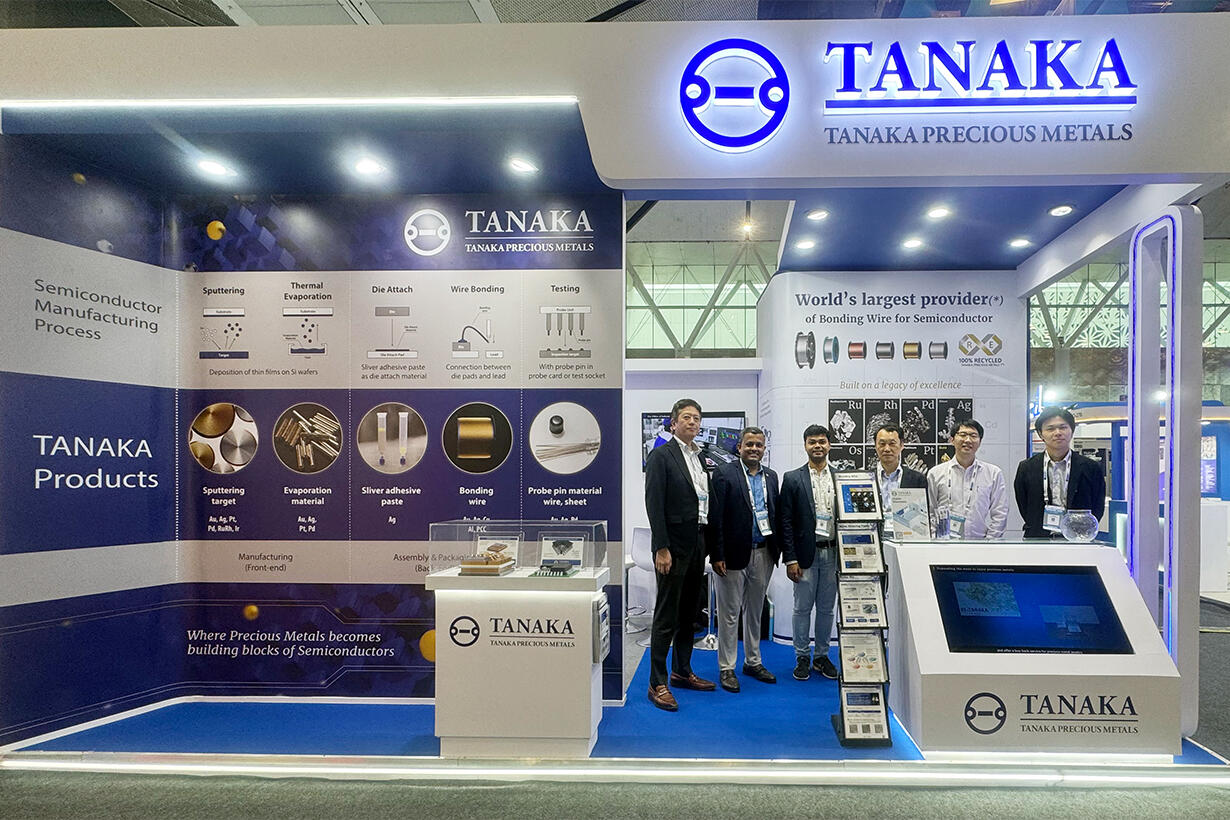
TANAKA is strengthening its semiconductor-related business. Drawing on its expertise in precious metals developed through many years of experience, the Group is also considering expanding into emerging semiconductor markets such as India. This article introduces three products from TANAKA's lineup exhibited at SEMICON India 2025: silver adhesive for die bonding, bonding wire, and Probe Pin material.
TANAKA, which will celebrate its 140th anniversary in 2025, is accelerating the strengthening of its semiconductor business. While best known for its TANAKA bullion/coins and precious metal jewelry, its industrial business, including semiconductor materials, accounts for 70% of its total revenue. Looking just at semiconductors, the company offers a wide-ranging product lineup, covering everything from pre- and post-processing to general-purpose chips and cutting-edge chips. While the company has been strengthening its globalization efforts for some time, it is also proactive in entering emerging markets in the semiconductor industry, as evidenced by its first appearance at SEMICON India 2025, an international semiconductor exhibition held in Delhi, India from September 2-4, 2025.
This time, we introduce three products used in semiconductor manufacturing from those exhibited at SEMICON India 2025. TANAKA emphasizes that “many visitors gathered at the booth, and we felt a positive response for all the products.”
Hybrid silver adhesives that achieve both heat dissipation and reliability
TANAKA offers silver adhesives for die bonding used to bond semiconductor chips cut from wafers to lead frames.
There are two main types of silver adhesives for die bonding: resin bonding and sintering. The sintering type, which bonds using a metallic bond, is made from silver (Ag) and a solvent, and has high thermal and electrical conductivity, but if there is a difference in the thermal expansion coefficient with the base material, peeling or cracking can occur, reducing reliability. On the other hand, the resin bonding type, which contains epoxy resin and bonds using hydrogen bonding, has low stress and high reliability, but its thermal conductivity is not as good as the sintering type.
Joining Materials Sales Section
Mr. Yoshinori Fushimi, Ag Adhesive Product Manager
TANAKA produces the TS-985 series, a hybrid sintering type silver adhesive that bonds using both metallic and hydrogen bonds. This product combines the best of both resin bonding and sintering types, and is characterized by its ability to achieve both high thermal conductivity, electrical conductivity, and reliability. Yoshinori Fushimi, product manager for silver adhesives at TANAKA PRECIOUS METAL TECHNOLOGIES Kogyo, explains, "With the recent evolution of power semiconductors, die bond adhesives are now required to have higher heat dissipation properties. We can meet that demand."
The TS-985 series can also be used as a substitute for lead (Pb) solder. “While Pb solder has been widely used due to its low cost and quick solidification, many companies are now refraining from using it with an eye toward the future as environmental regulations are being introduced, particularly in Europe. We are seeing a steady increase in demand for the TS-985 series from such companies,” says Fushimi.
The TS-985 series is also characterized by its good compatibility with copper (Cu) lead frames. The reliability of die bonding adhesives varies depending on their compatibility with lead frame materials. Copper is the mainstream material for lead frames, and die bonding adhesives are mainly based on silver; however, since the highest bondability is achieved when the same materials are used, lead frames may be plated with silver. Although the TS-985 series is a silver adhesive, it has good compatibility with copper lead frames and can be used without plating, thereby allowing the omission of the plating process and contributing to cost reduction.
TANAKA has research and development and manufacturing sites for silver adhesive pastes for die-bonding in Hiratsuka City, Kanagawa Prefecture, and Singapore. “Many of the power semiconductor manufacturers that are our customers have factories in Southeast Asia. TANAKA has been strengthening communication and support by establishing research and development and manufacturing sites close to its customers in Singapore ahead of its competitors” (Fushimi).
We will continue to enhance thermal dissipation while maintaining our strength of not requiring plating.
Bonding wire with high market share that has continued to supply without interruption even during the COVID-19 pandemic
TANAKA has a track record of over 60 years in the manufacturing of bonding wires used for electrically connecting semiconductor chips and printed circuit board electrodes, and has secured a high market share.

Second product department
Chief Manager Toshiteru Ogawa
TANAKA ELECTRONICS has a total of seven manufacturing sites, including one in Yoshinogari, Saga Prefecture, which is also a research and development site, as well as one each in Singapore and Malaysia and two each in China and Taiwan. This allows the company to reduce supply chain risks. According to Toshiki Ogawa, who is in charge of bonding wires at TANAKA ELECTRONICS, “We have systems in place to ensure that all our products can be manufactured at multiple sites, and we have continued to supply them without interruption even during the semiconductor shortages caused by the COVID-19 pandemic. Given the recent changes in the global situation, it is becoming increasingly important for semiconductor manufacturers to reduce supply chain risks, and we believe that TANAKA will be able to contribute to stable supply.”
TANAKA offers bonding wires in various materials, including gold (Au), silver (Ag), copper (Cu), and aluminum (Al), as well as Pd-coated copper (PCC), which has a palladium (Pd) coating on copper (Cu). In terms of wire types, TANAKA offers standard fine wire for general use and thick wire for power devices, as well as ribbon wire that can have a larger cross-sectional area than round wire without increasing thickness. As there is a trend toward the use of thinner bonding wires to reduce costs, TANAKA has developed ultra-fine bonding wire with a diameter of 10 μm during the research and development stage.
TANAKA customizes and supplies bonding wires according to customer specifications, including hardness and elongation. In addition, we utilize our expertise in precious metals to provide solutions that include bonding know-how, such as the compatibility of materials used for electrodes and wires.
“We will continue to develop products in line with our customers' needs. Drawing on our long experience in manufacturing bonding wires, we would like to respond broadly to our customers' needs” (Ogawa).
Probe Pin Material that Eliminates the Trade-off between Electrical Resistance and Hardness

Isehara Plant Materials Development Section
Manager Takeshi Fuse
We also offer products for the testing process. This is Probe Pin Material used in Wafer Test, the final stage of the preceding process, and Final Test, the final stage of the subsequent process.
In wafer testing, if the Probe Pin has high electrical resistance, heat will be generated, which can lead to the misjudgment of good products as defective, thereby reducing the accuracy of the tests. For this reason, low electrical resistance is a critical requirement for probe pin materials.
In response to this demand, TANAKA released the low-resistance Pd alloy material "TK-FS" in 2023. This material significantly reduces electrical resistance compared to conventional ones while maintaining high hardness. Kenji Fuse, who is the deputy product manager of materials for Probe Pins at TANAKA PRECIOUS METAL TECHNOLOGIES, explains that "TANAKA has eliminated the trade-off between electrical resistance and hardness through its unique composition and manufacturing methods."
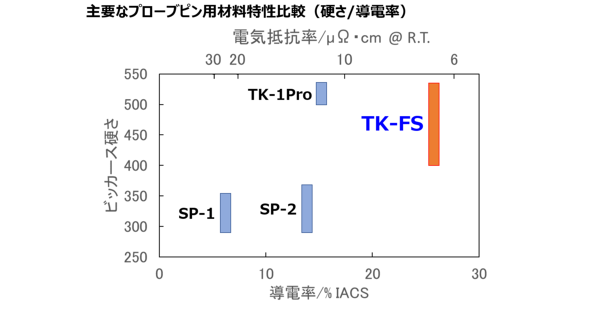
In addition, while general metal materials are more prone to cracking and breaking as they become harder, TK-FS has high levels of bending resistance and elongation. Since cantilever-type Probe Pins with bent tips are widely used in wafer testing for logic ICs, TANAKA conducts its own repeated bending tests on TK-FS.
TK-FS is sold as a custom product, and its hardness can be freely adjusted between 400 and 520 HV.
On the other hand, electrical resistance is not as high a priority as in wafer testing during final testing. This is because the accuracy of the test is determined not by the Probe Pin alone but by the entire system. Instead, since the tip of the Probe Pin wears during contact with the item being inspected, hardness is given very careful consideration.
TANAKA's Pd alloy material "TK-SK," released in 2024, meets these demands. Traditionally, the hardness of Pd alloys has been said to be "at most around 560 HV, no matter how high" (FUSE). However, TK-SK exceeds this limit, achieving a hardness of up to 640 HV. This product was developed by combining TANAKA's extensive development data accumulated over the years with a new manufacturing method focused on hardness.
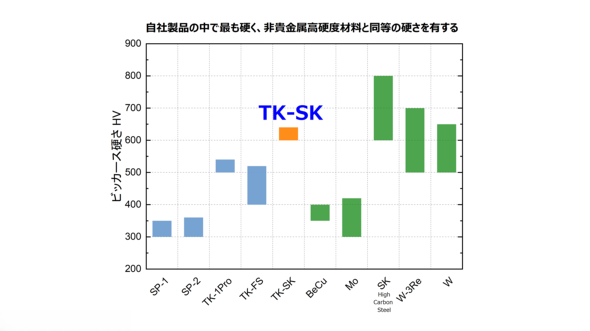
Materials used for Probe Pins include non-precious metal high-hardness materials such as BeCu alloy. Non-precious metal high-hardness materials have the characteristic of "high hardness but are prone to oxidation," and require plating to prevent oxidation. However, Pd alloy can be used without plating. Mr. Fuse confidently states, "TK-SK has hardness equal to or greater than that of non-precious metal high-hardness materials and has oxidation resistance that does not require plating, making it a superior material to non-precious metals."
“There are also requests for further reductions in electrical resistance for use in power semiconductor wafer testing” (FUSE), and the company will continue to develop its products while checking customer needs.
A Trusted Partner in Semiconductor Manufacturing Built on Years of Expertise and Trust
TANAKA leverages its deep knowledge of precious metals and many years of experience to provide a wide range of products that are essential in the various processes of semiconductor manufacturing. In addition to product quality, TANAKA also ensures stable supply and a solid support system, and will increasingly become a reliable partner for semiconductor manufacturers and inspection equipment manufacturers, who place importance on reliability.
Source: EE Times Japan
Excerpt from an article published in EE Times Japan on October 30, 2025
This article is published with permission from EE Times Japan.
How was this article?
If you found this helpful, please share it.


