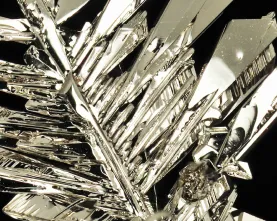

Ag 銀
Without silver, photographs would not have been born.
It is a familiar presence also used in mirrors.
Silver's Role in Mirrors
Silver reflects almost 100% of light. This characteristic has historically been used to make mirrors since ancient times.
A silver film is formed on the back side of the glass. This silver film is further protected by copper and resin films. Usually, we see the light reflected by this silver film through the glass from the front side of the glass. Since silver reflects most of the visible light, it is brighter than other metals and allows a clearer perception of natural light.
Precious Metal Element Data
| Atomic Number | 47 |
|---|---|
| atomic weight | 107.8682 |
| Stable Isotope | 107Ag,109Ag |
| crystal structure | fcc |
| Metallic | Trans.Metal |
| Shell structure | 2,8,18,18,1 |
| Occupied Orbit | 4d10 |
| Oxidation state | 1 |
| Atomic radius | 1.44 |
| Shared bond radius | 1.34 |
| Atomic capacitance | 10.3 |
| Density (293K) | 10.50 |
| Melting point | 961.78 |
| Boiling Point | 2162 |
| Specific heat | 0.235 |
| melting heat | 11.30 |
| heat of vaporization | 250.580 |
| Thermal conductivity (273K) | 428 |
| Electrical resistivity (273K) | 1.47 |
| Linear thermal expansion coefficient (293K) | 18.9 |
| First ionization potential | 7.57623 |
| Second ionization potential | 21.47746 |
| Electron Affinity | 1.302 |
| Electronegativity | 1.93 |
| Year of Discovery | Ancient |