

The evolution of power semiconductors that support the promotion of GX and the spread of EVs. This article examines the current state of material development that underpins this evolution.
- The two major roles of power semiconductors are power supply control and motor control.
- Power semiconductors to curb power consumption from the spread of generative AI
- Next-Generation Power Semiconductors Using SiC and GaN
- What are the intentions of the U.S., China, and India?
- TANAKA PRECIOUS METAL GROUP—Maximizing the Potential of Precious Metal Materials
Next-Generation Power Semiconductors Using SiC and GaN
Minamikawa: Power semiconductors using new materials such as SiC (silicon carbide) and GaN (gallium nitride) have improved power conversion efficiency to around 97-98%, for example. An improvement of 1% to 2% is a significant difference.
SiC was first mass-produced by Tesla. The heat resistance limit of ordinary silicon is about 125 degrees, but SiC is designed to withstand up to 250 degrees. This means that even in hot locations such as the engine room of a car, SiC power semiconductors can be placed close to the engine and motor. This can reduce the form factor (factors that determine shape and size) and is therefore very advantageous.
GaN (gallium nitride) is characterized by its ability to operate at high frequencies. High-frequency operation improves the efficiency of power conversion from AC to DC, DC to AC, and frequency conversion.
They are advantageous for improving power supply efficiency and are also contributing to the miniaturization of PC power supplies.
Currently, SiC is said to be 5 to 6 times the price of regular silicon and GaN is 7 to 8 times the price. The market is still limited, but I believe that as mass production begins and prices decrease, the range of applications will expand.
ABE: That's right. From the perspective of materials, SiC and GaN have a history of development that has addressed the challenges of stable crystal growth.
Namikawa: What do you think are the key points in developing materials for power semiconductors?
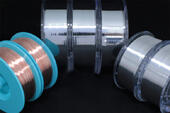
Abe: TANAKA PRECIOUS METAL GROUP has been involved in semiconductor packaging materials for a long time. Starting with bonding wires, the Group's involvement has now expanded to include die bonding materials and active brazing filler metals.
Based on this knowledge, we believe that both heat dissipation and reliability are important for materials used in power semiconductors.
The newly emerging SiC and GaN have different physical properties from silicon. For example, when actually processed to the thickness of a chip, silicon is said to be flexible while SiC is hard.
When chips are diced and finally bonded to substrates, if the substrate is hard, stress relaxation may not be sufficient due to differences in thermal expansion coefficients, which can lead to gaps and voids (cavities) between the chips and substrates. Voids can affect the density of the bonding layer and, in turn, the heat dissipation and reliability of the chips.
I believe that the key point in developing next-generation materials is to ensure performance and reliability by optimizing relay materials and bonding materials for chips and substrates with different physical properties.
Minamikawa: Certainly, power semiconductors are often used for long periods of time. In the case of solar power generation, the lifespan of panels is said to be 15 years, and they should last at least that long. Reliability is indeed very important.
Abe: In addition, due to its high voltage resistance, SiC can reduce chip size for the same current and voltage. It is said that compared to silicon, chips can be one-third to one-quarter the size for the same voltage resistance. However, miniaturization makes it easier for heat to accumulate, increasing the need for heat dissipation. I believe that the development of materials for next-generation power semiconductors will focus on heat dissipation, low resistance, and reliability.
Namikawa: Material development requires perseverance. I believe that it largely involves taking a long time and steadily continuing development. This is an area where Japanese companies excel, so I think Japan holds an important position in power semiconductors.
Related Information
Technology Trend and Advanced Packaging Material for Power Device
As energy-saving technologies for smartphones and electronic devices, next-generation mobility such as EVs, base stations, and power control for renewable energy continue to advance, the technological development of power semiconductors will increasingly require higher output and efficiency.
We will introduce cutting-edge materials and packaging technology trends to address issues such as high heat dissipation, high heat resistance, bonding reliability, and miniaturization.



How was this article?
If you found this helpful, please share it.


