

The evolution of power semiconductors that support the promotion of GX and the spread of EVs. This article examines the current state of material development that underpins this evolution.
- The two major roles of power semiconductors are power supply control and motor control.
- Power semiconductors to curb power consumption from the spread of generative AI
- Next-Generation Power Semiconductors Using SiC and GaN
- What are the intentions of the U.S., China, and India?
- TANAKA PRECIOUS METAL GROUP—Maximizing the Potential of Precious Metal Materials
What are the intentions of the U.S., China, and India?
Abe: Japan has long been at the forefront of research and development of power semiconductors, but now Europe, the United States, and China are also putting in effort. Could you tell us about industry trends in various countries around the world?
南川: China intends to take global hegemony through electric vehicles (EVs). China has the highest number of xEVs (electric, hybrid, and plug-in hybrid vehicles) in the world, and nearly 40% of new cars are xEVs. Japan is also high, but around 30%. Europe and the United States are around 20%.
This is why China uses a lot of power semiconductors and is also putting effort into their development as a nation.
安部:Do you think that trends in countries as technology development and manufacturing locations are linked to those as demand locations?
Namikawa: Until around 4 to 5 years ago, the semiconductor industry was globalizing, and supply chains were in place that manufactured and supplied semiconductors worldwide according to the right materials and places, such as those with low costs and those with many engineers.
This has changed dramatically since three years ago. Semiconductors are the most important technology in terms of economic security, and as it is called decoupling, technology is not provided. For example, the United States has very strict regulations on China.
安部: Do you expect that U.S. regulations will continue to be maintained for the time being?
Namikawa: This is likely to continue for a long time. In December last year, a bipartisan report titled "Reset, Prevent, Build" was released by the U.S. Congress. This will be the U.S. consensus that will remain unchanged even if the administration changes.
Reset means that we should also reconsider our business with China. Prevent means that we will no longer provide technology. Build means that, as our business with China shrinks, we need to establish new markets as alternatives.
ABE: I see. What are your thoughts on the growing expectations for India?
Namikawa: To conclude, I believe that it will start moving in earnest. This is largely because the United States' thinking will be a major driving force and support, and also because the Indian government has decided to provide subsidies on the scale of 2 to 3 trillion yen in the coming years.
It will take time. It took China nearly 20 years for its semiconductor industry to grow to this size. So even if it is faster than that, it will take 10 to 15 years.
安部: Compared to the past, is the amount of subsidies from the Indian government this time significantly impactful?
Minamikawa: It's large. In the past, it was several hundred billion yen to around 1 or 2 trillion yen. This time, it's 2 to 3 trillion yen, so the scale is on a different level. They are also currently developing a new site for accumulation and say they will start in earnest.
This is a good time as China’s population is no longer growing and its economy is slowing down. Until now, China has been a major growth engine for the world, but with this engine slightly weakening, there is a global demand for the next growth engine.
ABE: So, you see India not only as a production base but also as a market.
Namikawa: There is a very high correlation between population and world GDP as electronic devices grow.
As the population increases, GDP will increase. As GDP increases, consumption will increase. Individual consumption accounts for about 50% of the world's GDP. The demand for semiconductors will grow as individuals buy computers, smartphones, and home appliances through personal consumption.
In addition, demand is expected to grow in the future in the areas of DX (Digital Transformation) and GX (Green Transformation). This is not for individuals. It is a matter of government policy on where to invest, and is similar to infrastructure.
I believe that, in addition to personal consumption, government consumption will emerge as a driver of growth.
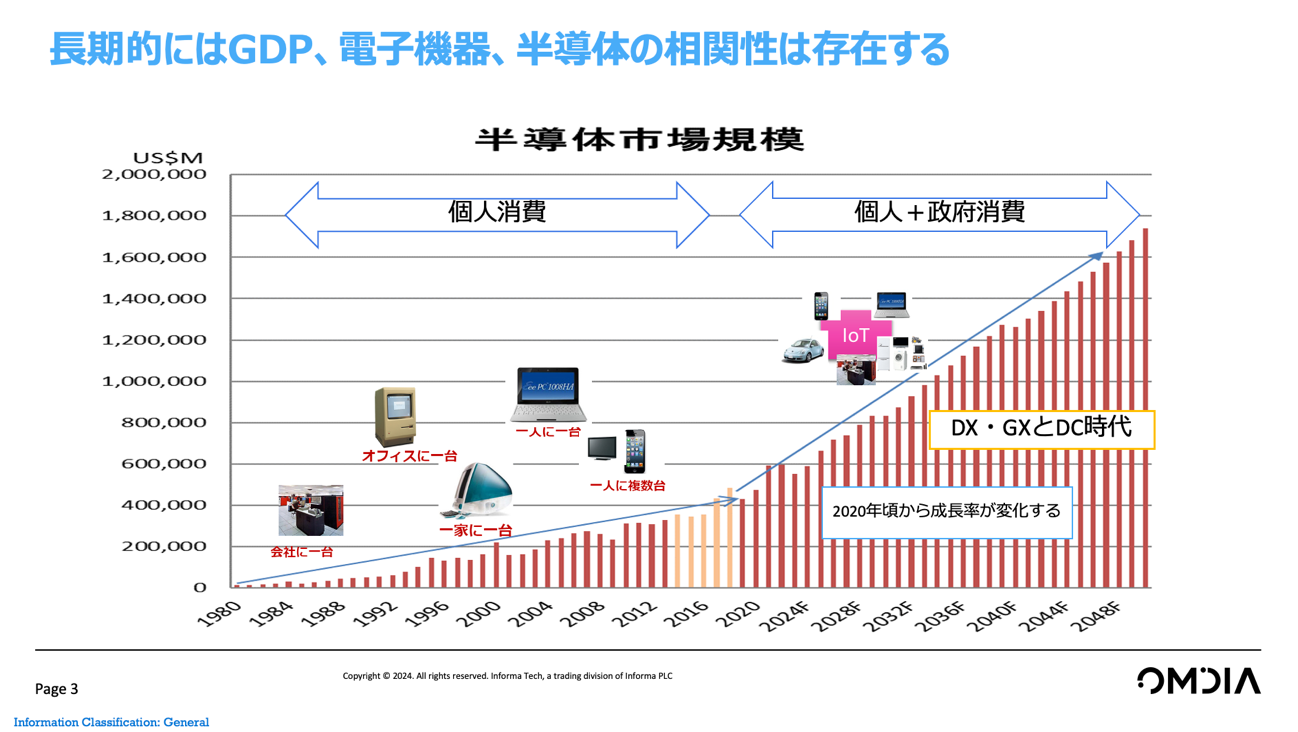
I expect the pace of market size expansion to accelerate around the late 2020s, and from this point onward, electricity consumption will significantly increase. This is due to AI. Therefore, materials are important to help reduce electricity consumption.
ABE: The next material will definitely be needed.
SiC has already entered the phase toward mass production, and I think GaN will take a little more time, but I believe that this trend is definitely correct from a medium-term perspective.
Related Information
Technology Trend and Advanced Packaging Material for Power Device
As energy-saving technologies for smartphones and electronic devices, next-generation mobility such as EVs, base stations, and power control for renewable energy continue to advance, the technological development of power semiconductors will increasingly require higher output and efficiency.
We will introduce cutting-edge materials and packaging technology trends to address issues such as high heat dissipation, high heat resistance, bonding reliability, and miniaturization.




How was this article?
If you found this helpful, please share it.


